




Please Follow us on Gab, Minds, Telegram, Rumble, GETTR, Truth Social, X, Youtube, Instagram
Originally published at Hank's Substack.
The 2026 midterm elections are behind us. Republicans were routed. While the party chief blames everyone else, a central question becomes obvious: What has happened to the once-dominant Georgia Republican Party? For the last three years I have chronicled the transfer of influence from grassroots Republicans to political insiders, a fact which is central to the loss of support and interest in election participation by a generally conservative electorate. Chairman Josh McKoon did not create every problem. But since becoming chairman in 2023, he has had the responsibility—and the opportunity—to address them. Instead, he abandoned his pledge to fulfill that purpose and became an integral part of the problem.
This series concisely revisits numerous issues I have raised in the past, while focusing on the future. Readers who want the underlying research of this article can begin with my September 19, 2023 article, “Kemp’s Ultimate Goals Now Coming Into View—The Privatization of Georgia’s Election Processes.” Its central questions remain as relevant today as when I first raised them: (1) Who actually controls the Georgia Republican Party, and under what authority? (2) How has the corporatization of Georgia’s election institutions affected the viability of the Georgia Republican Party?
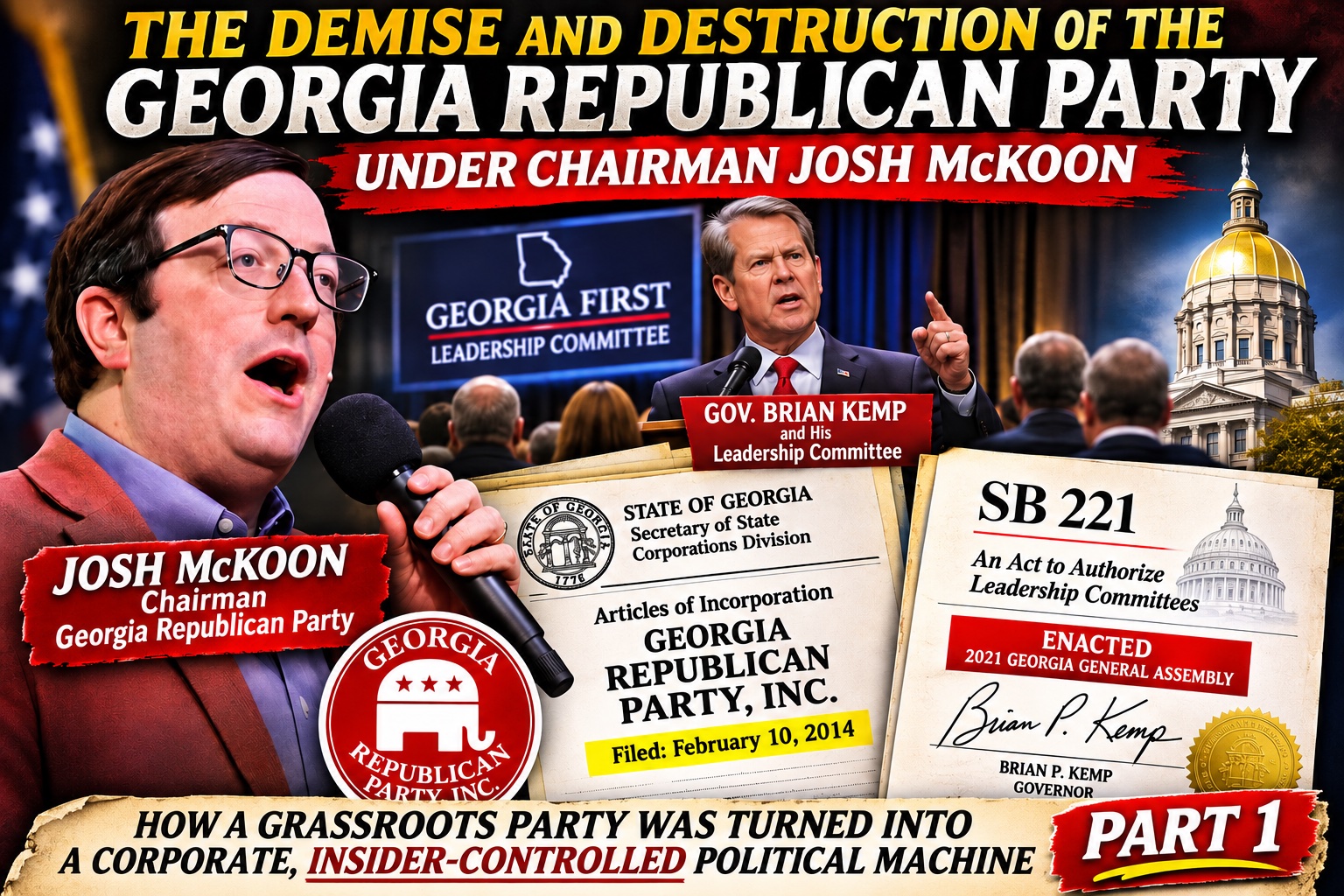
In February 2014, while Brian Kemp was Georgia’s secretary of state, a nonprofit corporation named Georgia Republican Party, Inc. was formed under Title 14 of Georgia law. John Padgett, then Chairman of the Georgia Republican Party, was associated with its formation and leadership. That filing is important because Georgia’s election laws, including provisions governing political parties, appear in Title 21, not 14. Corporate law and election law serve different purposes, with different, non-interchangeable authorities and characteristics.
A party-associated corporation is not inherently improper. Political organizations may use corporate entities for administrative and financial purposes. My concern was—and remains (1) whether party officials have adequately explained the relationship between the corporation and the political organization that exercises rights under Georgia election law, (2) whether they understand it themselves, and (3) whether they have properly utilized those entities under Georgia law.
Over time, the party publicly migrated to using the name Georgia Republican Party, Inc., including that name in its rules. Almost miraculously, the same individuals elected to party leadership also appeared as officers of the corporation in annual registrations. In 2023, following McKoon’s election as chairman, he became listed as the corporation’s CEO. Those overlapping roles raise a straightforward question: Where does the authority of the grassroots, Title 21 party end, and where does the authority of the Title 14 corporation begin?
A party whose legitimacy rests on its members, delegates, conventions and voters should be able to answer that question without hesitation.
When I examined this arrangement in 2023, extensive efforts by others to obtain historical party registration records from state offices had not produced the documents requested. The lack of documentation did not establish the party had ceased to exist or any nomination was unlawful. But it exposed a serious transparency problem. The public should not have to speculate about the legal identity and governing authority of a major political party.
Acknowledging the legal questions, rather than resolving the ambiguities publicly, party leadership ignored them and continued operating under the corporate name. McKoon, himself an attorney, was particularly well positioned to understand and rectify the legal framework. In a 2023 interview, he acknowledged that the party’s bylaws and corporate documents might need altering to restore the party under the requirements of election law.
That observation was revealing. If the governing documents needed clarification, what exactly was the problem? Who has the authority to correct it? And why has the situation persisted for years with no examination?
These questions are not technicalities. The blending of legal entities defined under differing Titles of law blurs the chain of accountability between Republican Party members, their elected delegates, the state executive committee and the chairman.
At the same time, Governor Brian Kemp was building political influence outside the traditional party organization. In 2021, at Kemp’s direction the general assembly passed SB221 authorizing leadership committees, corporate entities which permit eligible political leaders to raise and spend funds under rules differing from those governing ordinary candidate committees. Kemp’s Georgians First Leadership Committee became an indomitable vehicle for political fundraising and influence.
Kemp told his supporters that Republicans could no longer rely on traditional party infrastructure to win future elections. The governor was not merely expressing frustration with party operations. He was describing a personal political strategy in which a separately financed, corporate organization could perform functions once associated with the party, while centralizing political control under one statewide elected official—himself.
A broader danger is plain: when elected officials, powered by unlimited contributions from anonymous donors, build political machinery independent of the party, the grassroots organization loses leverage over the politicians it helps to elect, and its members lose interest.
A chairman committed to grassroots authority should challenge that power imbalance, not accept it. Josh McKoon, however, retains his $230K/year day-job with the State of Georgia at the pleasure of the governor. Perhaps you understand the conflict.
And this is where my criticism of Josh McKoon begins. He inherited an organization with unresolved questions about its corporate identity, its governing documents and its relationship to the political establishment. He also inherited a party led by a governor who had openly questioned the usefulness of that same party and abandoned his role as tantamount party leader.
McKoon’s job was not simply to manage elections, raise money or maintain relationships with powerful Republicans. It was to defend the integrity and independence of the party organization entrusted to him by convention delegates. That required clear answers about corporate governance, transparent accountability and an unmistakable commitment to the grassroots Republicans whose participation gives the party its legitimacy.
I do not contend that the existence of Georgia Republican Party, Inc. alone destroyed the party. I contend that the willingness of its leaders to leave fundamental questions unanswered is evidence of institutional decline and an accompanying loss of legitimacy in the minds of Republicans.
The 2026 midterm collapse raises another question. Can a political party remain electorally competitive while becoming less responsive to the people it claims to represent?
This is the demise I intend to examine in this series, causing the degradation of party member interest, and support, in participating in the elections processes. The question for Josh McKoon is whether he will spend the rest of his term working to restore that control, and interest—or preside over the party’s utter destruction.









Get the latest on Georgia delivered straight to your mailbox.