







Please Follow us on Gab, Minds, Telegram, Rumble, GETTR, Truth Social, Twitter, Youtube
In a gratuitous assumption of newly-enacted governmental powers never before exercised by county governments in Georgia, the Forsyth County Commission has taken steps that threaten long-established businesses with termination of their grandfathered land use rights. An ordinance enacted by the county commission on August 7th would potentially allow the termination of land use rights essential to the continued operation of those businesses when IN THE OPINION OF COUNTY GOVERNMENT BUREAUCRATS their uses of land vary from those grandfathered under the present Unified Development Code (UDC). Forsyth County citizens should deeply consider that this new ordinance places the question of continuing operations for long-standing Forsyth County businesses, many being family-owned, into the hands of hired government bureaucrats. Under the new ordinance, the determination whether a “legal non-conforming business” falls into that category will be an administrative decision by the Forsyth County Planning and Development Department under its Director Tom Brown. The ordinance can also affect grandfathered residential property rights under similar circumstances.
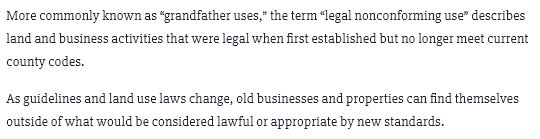
Many of those legal non-conforming, or “grandfathered” businesses have been operating longer than the Forsyth County UDC has been in effect. But once the UDC was passed in 2000, and zoning changes were made, many land and business owners (or operators) found themselves operating outside of the newly established zoning requirements, even though they may have changed nothing in their land use or business activities during that time. Appropriately, those businesses were “grandfathered in,” Forsyth County permitting them to continue operating as they had prior any zoning changes.
But that was then, and this is now. And now the Forsyth County Commission is taking steps to “phase out” grandfathered land uses, the Forsyth County News reporting on the new ordinance in the following way:
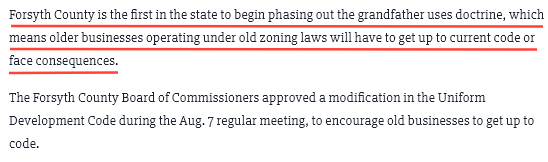
According to FCN,
To justify enacting this new code, during the August 7 commission meeting, County Attorney Ken Jarrard interjected to outline the parameters of this insidious new ordinance, written by his firm at the commission’s request, offering remarks which also discuss the code’s triggering mechanism with respect to discontinuing grandfathered land uses.
In his remarks, Jarrard chose to illustrate the ordinance using an obvious worst-case hypothetical, not surprisingly one with which many or most Forsyth County citizens might sympathize. The case he posited was the operation of puppy mills at personal residences, or what Mr. Jarrard simply called, “kennels.” Obviously, most people align against puppy mills, so who could be against such an ordinance, right?
Mr. Jarrard’s chosen example appears a “too obvious” attempt by the Forsyth County Commission to manipulate public opinion to support a massive county government “power grab” over untold acreages of land, previously out of the commission’s immediate control, and located all throughout “the fastest growing county in America.” This new county code, ground-breaking with respect to all other Georgia counties, is not simply an “anti-puppy mill” measure. Instead, the new ordinance empowers Forsyth County Government to outlaw previously-grandfathered land uses and businesses from operating as they have, in some cases even before our county commissioners were born.
Below you may find Mr. Jarrard’s remarks in their entirety:
Disentangling the county attorney’s explanation of the ordinance, it appears that IF IN THE SOLE OPINION OF PLANNING AND DEVELOPMENT DIRECTOR TOM BROWN, a “legal non-conforming use” sufficiently differs beyond how that land was used on the day of a zoning regulation change (a criteria which could mean virtually anything), the owners or operators using that land would be subject to receiving a county citation. The citation is the ordinance “trigger mechanism.” Once a citation is issued, an 18 month clock begins to tick. If the land owner/operator does nothing during that time, or if the land owner/operator tries to make quick dispatch of the notice by simply paying the citation, THE GRANDFATHERED STATUS OF THE ASSOCIATED LAND USE IS IMMEDIATELY FORFEITED FOREVER, WITHOUT RECOURSE.
This ordinance provides one layer of appeal for the owner/operator of the land. Once an unproved, unadudicated citation is received, in order to appeal the OPINION OF MR. BROWN, that land owner/operator would be forced to go before the county Zoning Board of Appeals (ZBA). If not satisfied with that outcome, the owner/operator would be forced to take the county to superior court, and prove that the grandfathered use presently in operation has not changed since immediately prior to the county commission rezoning the property, an event which might have occurred decades ago. In such case, a tantamount presumption of guilt would likely precede any court action because, practically speaking, the offending change could be literally anything Mr. Brown, representing his planning department, might allege and has administratively determined, and Brown’s case would have already been upheld by the ZBA.
Whether backed by facts or not, under this ordinance Forsyth County could immediately initiate a program of issuing citations to land owner/operators all over the county. Land owner/operators would then be given 18 months and forced to prove the planning director wrong in his judgments of their circumstances, conceivably having to rely on such evidence as aerial or ground-based photographs taken and date-stamped at the time of a zoning change. That kind of evidence would be difficult to obtain and likely does not exist.
So, land owners or operators caught under the umbrella of this new code and its trigger mechanism would have a battle on their hands, and without tangible evidence to prove Mr. Brown or his successors absolutely disconnected from reality in their determinations, they would likely lose their justified appeals, along with the grandfathered uses of their land and be forced to relocate or lose their businesses. Under this ordinance, long-standing family businesses could be forced to shut down and sell out to other businesses presently in keeping with today’s zoning, thus accomplishing the stated goal of the Forsyth County Commission’s new ordinance, the “phasing out of grandfathered land uses.”
You might recall, in a previous Substack I asked the question, “Who is really running Forsyth County?” Today, I renew that question because, frankly, I do not believe any of these commissioners would have the ability to dream up such an intricate, groundbreaking, land and power grab scheme on their own.
Needless to say, this startling new code has business owners operating under grandfathered, legal non-conforming use status concerned. The administration of these code parameters are all subject to bureaucratic interpretation and execution, a fact which opens the door for abuse, and even political targeting. Imagine, for example, the potential repercussions against a business owner operating under a grandfathered use, but who happened to contribute to the campaign of an opposing county commission candidate. Do you see how this ordinance could, and perhaps would be abused? Sure you do.
Now, according to local attorney Ethan Underwood speaking at the meeting during which this ordinance was passed, there is no Georgia statute underwriting the power assumed under this ordinance. In other words, the WILL OF THE PEOPLE OF GEORGIA expressed in legislated law, has never authorized this kind of potential abuse by county governments against local businesses and land owners. According to Mr. Underwood, the “dicta” underwriting the presumed legal authority of governments terminating grandfathered land uses of businesses and land owner/operators, is one found loosely woven into the outcomes of a handful of Georgia court cases, and originates in a treatise out of Massachusetts entitled Rathkopf’s The Law of Zoning and Planning. That treatise is an active compilation of ever-evolving case law on the subject. Case law essentially means “common law,” which finds its authority in the opinions of a court, perhaps even the opinion of a single, isolated judge motivated by certain local circumstances, rather than in any general statement authorized by the will of the people of Georgia as reflected by duly-enacted legislation. Here are Mr. Underwood’s remarks:
So when Mr. Jarrard claims, “the law says that government has the opportunity to phase out legal non-conforming or grandfathered uses over a reasonable period of time,” the county attorney apparently overstates any common usage of the term, “law.” In his statement, Mr. Jarrard appears to synthesizes Georgia “law” out of certain isolated court opinions from certain selected cases, issued somewhere in the nether reaches of Georgia. According to Mr. Underwood, those cases on which Mr. Jarrard bases his claim are themselves based on court opinions appropriated from outside of Georgia and found within the pages of the RathKopf compendium. Apparently, therefore, Mr. Jarrard does not base his claim on any “law” legislated and authorized by the will of the people and enshrined in the Official Code of Georgia. The authority for this kind of local ordinance is therefore extremely weak and questionable, and is reliant upon certain isolated court opinions cited in the Rathkopf treatise, carefully selected for legal argument somewhere in Georgia. During the August 7 commission meeting, the county attorney, apparently erroneously, portrayed the legal authority for the new ordinance to apply universally, without question, across Forsyth County and the State of Georgia.
According to the knowledge of Mr. Underwood, arguing as a private citizen and representing no other interest, Forsyth County would be the first jurisdiction in Georgia to assume the powers of this new ordinance, remarking, “I’m a little surprised that the most conservative district in Georgia is going to be the first to tell people, ‘You know what, at some point we want you to take your business and go away.’” Underwood maintained that in the future this ordinance could establish an “unstable business environment” and potentially motivate new businesses to establish elsewhere than Forsyth County for fear that a future zoning change could destroy their invested businesses.
Responding to Mr. Underwood, Chairman John and Commissioner Mendy Moore offered their thoughts, John pushing back against the idea that the county might use this ordinance in ways unbeneficial to the business community, potentially doing so by merely disallowing grandfathered businesses “to continue to behave in…not good faith.” Chairman John’s remarks necessarily assume that governments, and therefore the politicians who ultimately control them, always operate in good faith in determining whether private business owners or operators do the same, a conclusion which, if history be our teacher, is largely unfounded.
Commissioner Moore’s remarks particularly perk the ears of business owners operating under legal non-conforming use status, expressing, “18 months gives them time to come in and apply for that use before us and us decide whether or not that is an appropriate place, and appropriate business for that location.” Perhaps Ms. Moore’s remarks were uttered unartfully, however, taking her at her pronouncement, it is difficult for some business owners or operators not to feel apprehensive or even threatened that employee bureaucrats in their county government would have the power to potentially destroy their livelihoods, as well as the livelihoods of their employees, using a planning director’s edict, one perhaps even urged forward by the will of certain commissioners, based on an arbitrary however convenient portrayal that the continued operation of a long-established and successful business is suddenly “inappropriate for its location.” As you can see, the ordinance in question is ripe for abuse.
Commissioner Moore, however, insisted that this ordinance only “targets bad actors.” It is my experience, however, that laws should never be judged by what a lawmaker says, but rather by the authorities the laws convey. Once on the books, laws will generally be applied following the latter, and not the former.
And for Commissioner Moore to portray that legal non-conforming business owner/operators would be required to “come before us” for “us” to decide whether or not their long-established enterprises are “appropriate for their locations,” when those businesses have been successfully operating as located for decades, smacks of government crowning itself royalty. Our founders believed that government is a necessary EVIL, and that government’s primary purpose is to SECURE THE RIGHTS OF THE GOVERNED, NOT DESTROY THOSE RIGHTS. Our founders were so concerned that governments might undertake to limit the rational and natural use of private property, as we see potentially happening here, that they enumerated the right to property, and its reasoned use, as SACRED and PROTECTED UNDER THE UNITED STATES CONSTITUTION.
In colloquial terms, this ordinance approved by the Forsyth County Commission is a simple “power grab” supporting a “land grab.” This action by the commission is a “usurpation” of the powers retained by the people of Georgia. The powers of this ordinance, retained and never conveyed to government by the will of the people, thereby materialized out of nothing. The will of the people of Georgia has never legislated to authorize the particular local powers assumed by the Forsyth County Commission under this ordinance. Our founding fathers believed that the use of governmental power without requisite authority serves to define the term, “tyranny.” And apparently, this move is a prime illustration of that term.
Those powers, newly-conjured and usurped by the Forsyth County Commission, now threaten all grandfathered Forsyth County businesses and land uses with the prospect that soon a county code enforcement officer will serve them a citation, signed by Mr. Brown or one of his successors, instructing them that before 18 months elapse, they must prove the planning director wrong in a designated venue of governmental adjudication, or they can expect their grandfathered statuses to be terminated. Because the powers of this ordinance are not conveyed by the will of the people, as they are not authorized under Georgia statute, their general use across Forsyth County can only reasonably exist constituting an abuse of local governmental power.
Almost certainly, upon considering this new Forsyth County ordinance, our founding fathers would find themselves rolling over in their graves.
What you just read should more than startle you, and is one more major reason the people in every district in Forsyth County, and in particular District 1, should support my candidacy to become a member of the Forsyth County Commission. Presently, citizens and businesses in Forsyth County are losing valuable property rights under this regime. Please know that if I am elected commissioner from Forsyth County’s District 1, I will leave no effort behind to dissect and kill ordinances such as the one offered by the county attorney in this case. Furthermore, I will defend individual and business property rights, and in particular, defend grandfathered property rights of businesses and land owners, and work to peal back layers of potential encroachment on those rights by hostile or abusive acts of county government.
To support my candidacy to become District 1 Forsyth County Commissioner, please click the following link.











Get the latest on Georgia delivered straight to your mailbox.

The Demonocrats want to seize your property; that way, they’ll have land to start building condos/apartments for the illegals when the Demonocrats are back in full control ! AND, American citizens will probably have to subsidize the illegals’ rent payments. I don’t know, they might give them FREE rent !