







Please Follow us on Gab, Minds, Telegram, Rumble, GETTR, Truth Social, Twitter, Youtube
by Wendi Strauch Mahoney for The Georgia Record
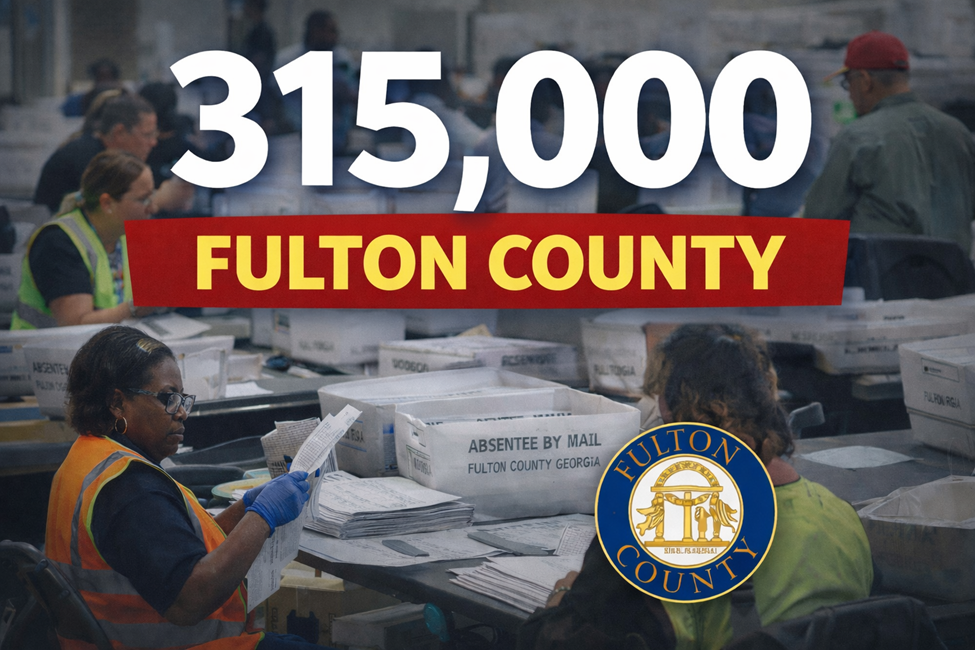
After years of diligently writing about Georgia’s Fulton County election, reporting by Brianna Lyman at The Federalist seems to have set the internet on fire regarding the 2020 election by simply reporting that the Fulton County Board of Registration and Elections (FCBRE) finally admitted it fraudulently counted roughly 315,000 votes. Ironically, these allegations have been well-documented in Fulton County election integrity investigations. And sadly, it is almost guaranteed that Fulton County is banking on using any such admission to soothe public outrage and make public outcry vanish. “See, we admitted it. We gave you what you wanted. Move on,” is what the Fulton County BRE hopes we will do. Not so for people like Kevin Moncla and Joe Rossi, among several others.
Kevin Moncla is intimately familiar with the egregious malfeasance alleged in the Fulton County elections. On Monday, Moncla shared a memo with me that crisply revisits the abject and unlawful behavior, he says, lies behind those 315,000 allegedly fraudulently counted votes, arguably a much more important story than the admission itself. His investigation is extensively documented and, in his view, unassailable. He writes, “There is no justifiable reason for the actions of Fulton County,” given what he and others have discovered. “Said another way,” Moncla continues, “the steps taken by Fulton County were intentional and deliberate to conceal something.”
Moncla’s memo states that Fulton County’s 2020 advance-voting tabulator records were incomplete, legally noncompliant, and indicative of intentional concealment, “prima facie fraudulent,” And “they were also not signed,” he adds. He further asserts that “all of the ballot images have been destroyed.”
His investigation claims that the required Georgia “process controls” (logic & accuracy, chain-of-custody, sealed tabulators, zero tapes reconciled with closing tapes, daily recap sheets, and other reconciliation checks) were bypassed—producing official returns (closing tapes) that cannot be reconciled to the machines that actually scanned ballots. This would leave roughly 315,000 advance-voting ballots/votes without auditable provenance.
Beyond noncompliance, the memo argues the surrogate-tabulator process masked the identity of the actual scanning devices, making forensic reconstruction or reverse-accounting difficult if not impossible.
Surrogate tabulators are an issue because even if memory cards contain results, a tabulator’s printed tape always reflects the tabulator’s own serial number and protective counter, not the originating scanner’s identifiers.
As such, printing closing tapes on surrogate tabulators breaks the “bookend” link between the zero-tape and the closing tape for each machine, prevents lawful completion of required seal/serial/counter verification measures, and yields “official returns” that cannot be tied to the scanners that actually processed the ballots. Moncla asserts, with evidence, the steps taken were “intentional and deliberate” and not a good-faith logistical workaround, noting there were allegedly “more than enough tabulators” to avoid such measures.
Moncla’s memo provides a more complete description of the way Georgia’s controls are designed to preserve a verified chain of custody and enable reconciliation at the machine level. However, the shorthand version is that during Logic & Accuracy (L&A) testing, election staff should insert tabulator memory cards, apply security seals, and document serial numbers and seal numbers on L&A checklists. The first day of advance voting should begin with a required “zero tape” printed from each scanner, showing the machine’s serial number, its non-resettable protective counter (lifetime ballots scanned), and a confirmation that zero ballots have been counted. The relevant information should be documented on a “daily recap sheet”, which is a manual log that Georgia law requires be kept and updated daily. Another daily benchmark is the “status tape” which is printed automatically each day when the tabulators are powered on. On Election Day, each scanner prints closing tapes that should “bookend” the election with the zero tape: same serial number, protective counter increased by the number of ballots cast during the election, and required signatures/witnessing. Daily recap sheets serve as contemporaneous handwritten logs that Georgia law mandates must be consulted to reconcile machine counts and seal numbers.
The memo alleges that Fulton County’s 2020 advance-voting records fail controls in multiple, compounding ways:
Closing tapes allegedly come from “surrogate” machines, not the scanners that processed ballots.
The memo claims that, for advance voting, Fulton County produced closing tapes that display the serial numbers and protective counters of different tabulators (“surrogates”) rather than the tabulators used to scan ballots. It states that, after months of records requests, Moncla and separately, Garland Favorito, obtained only 9 zero tapes out of 148 tabulators that reportedly produced results (as indicated by the Cast Vote Record (CVR)), and that none of 138 closing tapes reconcile with the available zero tapes. Because a tabulator tape prints the identifiers of the physical machine producing it, the document argues the closing tapes cannot serve as valid “official returns” for the scanners that actually counted the ballots.
Memory cards were allegedly removed early, seals broken, and chain of custody broken.
The memo asserts Fulton County cut tabulator security seals and removed memory cards for all advance-voting scanners before Election Day—contrary to the cited Georgia rule requiring memory cards to remain in the scanner throughout advance voting until polls close. It alleges there was no valid chain-of-custody documentation for these cards, and that four days later the cards were inserted into different tabulators to print closing tapes. The document emphasizes that this gap—identified as between October 31, 2020 (end of advance voting) and November 3, 2020 (Election Day)—left election result files vulnerable to undetectable manipulation and deprived the system of the reconciliation checks that should occur while seals and counters can still be verified against daily recap sheets.
Required reconciliation checkpoints were allegedly bypassed entirely.
Georgia regulations require election officials to verify the following: seal numbers against daily recap sheets, integrity of seals, and election counter numbers against voter accounting records; and to halt processing if discrepancies or evidence of tampering exist. The memo claims Fulton County’s surrogate-tabulator process made compliance with these checkpoints impossible, because the serial numbers and protective counters printed on the tapes would not match the scanners that actually ran ballots—yet the county proceeded anyway.
Advance-voting closing tapes were allegedly not signed/certified.
The memo alleges that none of the advance-voting poll closing tapes were properly signed, witnessed, or certified, describing this as a repeated violation of Georgia requirements. It further claims Fulton County offered false explanations for the missing certifications, including an assertion attributed to a records custodian that signing was not required at the time.
Supporting records are alleged to be missing or destroyed, preventing reconstruction.
According to the memo, there are no supporting records sufficient to reconstruct or validate advance-voting tabulation, alleging the absence or destruction of ballot images, the absence of nearly all zero tapes, and missing daily recap sheets and other voter-accounting records (such as check-in lists/numbered voter lists). It argues that, as a result, advance-voting totals—described as roughly 315,000 ballots—lack provenance and cannot be reliably audited back to specific scanners and sealed operational states.
See below from the memo the exhibit featuring the way the tabulator zero and closing tapes should properly reconcile in a lawfully conducted election:

The memo mentions several other important related complaints about which I have reported extensively. One, SEB2022-024, (filed March 28, 2022) details the advance-voting allegations. It was “administratively dismissed” without anyone’s knowledge but has been resubmitted. It “awaits proper investigation.” The second references a complaint submitted by Moncla and David A. Cross documenting the same failures for Election Day tapes not being properly certified and can be found here.
The third is SEB2023-025 and mentions the ten outstanding (disappeared) closing tapes. The timeline for SEB2023-025 can be found here. Note also that Phillip Davis, aka @MadLiberals wrote a program to detect duplicate ballots in Georgia’s 2020 election. Davis’s investigation was key evidence used to support claims of duplicate ballots in SEB2023-025. Davis reportedly identified 3,930 double scanned ballots in the Fulton County recount, among other discoveries. SEB2023-025 raised significant issues affecting 41,690 votes of uncertain provenance, well in excess of the statewide margin of victory of 11,779 votes for Biden in the 2020 Presidential election contest.
Moncla, who is highly skeptical of any sudden, sheepish and conciliatory admissions, argues that Fulton County’s “handwashing” was designed to shut down further scrutiny. He says the State Election Board’s repeated attempts—through subpoenas—to obtain the election records went nowhere, prompting a request for intervention from Harmeet Dhillon in the Justice Department’s Civil Rights Division. Dhillon responded with an October 30 letter to the Fulton County BRE, but the county allegedly continued to resist—resistance that has now escalated into a federal lawsuit against Fulton County.









Get the latest on Georgia delivered straight to your mailbox.


[…] Department of Justice, the FBI, our intelligence apparatus, and the exposure of the Deep State and rampant election fraud in the 2020 and 2022 elections are only a few of the scandals that have convinced normal Americans […]