







Please Follow us on Gab, Minds, Telegram, Rumble, GETTR, Truth Social, X, Youtube, Instagram
Georgia’s State Election Board executive director has formally asked the U.S. Department of Justice to intervene before the November 2026 midterms over the state’s Dominion voting system, citing unverifiable QR-code tabulation, documented security and ballot-secrecy flaws, restricted access to election records, and the sharing of voter and motor-vehicle data with outside groups.
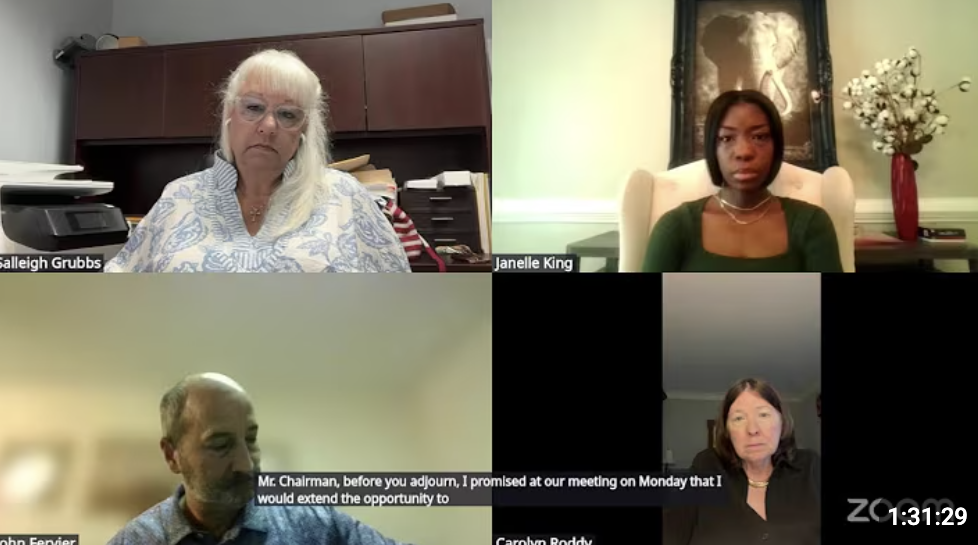
James Mills sent the three-page letter, dated September 30, 2026, to Assistant Attorney General for Civil Rights Harmeet K. Dhillon. It was copied to Attorney General Todd Blanche and Homeland Security Secretary Markwayne Mullin. The request follows a September 28 resolution, introduced by board member Carolyn Roddy and adopted 3-2, directing Mills to seek federal help on software updates and related issues.
Early in-person voting in Georgia begins October 13.
What the letter alleges
Mills wrote in his capacity as executive director that he was requesting DOJ review, investigation, and intervention on Georgia’s voting system, ballot secrecy, preservation of election records, and data-sharing practices, with the general election approaching. The letter lists nine concerns about the Dominion Democracy Suite 5.5-A system used statewide (the company has since been acquired and rebranded as Liberty Vote):QR-code tabulation is inconsistent with the Help America Vote Act’s voter-verification requirements and undermines ballot secrecy. Scanners count the machine-readable code, which voters cannot read, rather than the human-readable text printed on the ballot.
Georgia is running its voters through software with known, documented vulnerabilities that have been identified by the feds, and Georgia has not installed the certified patches for these vulnerabilities even though they are available.
The underlying operating environment is obsolete and unsupported.
The voting system described can be compromised in seconds with an ordinary ballpoint pen. This fact was demonstrated in federal court.
Votes are secretly linked to their ballots.
Shared statewide equipment credentials and unified key configurations to govern usage of the equipment could compromise accountability by different users on different days sharing the same credentials to access the same equipment using the same keys.
The Secretary of State’s office has also been accused of deceitfully misleading the legislature and the public as to the cost, feasibility and necessity of putting a fix in place for the identified problems.
Restrict access to the State’s election records, preserve those records currently under suspicion of having been altered, and demand a full investigation into such allegations.
The agreement entered into by the Secretary of State for Georgia with ERIC (the Electronic Registration Information Center) to share voter registration information and motor vehicle information with citizens of Georgia, has been shared with the outside organization Center for Election Innovation and Research (CEIR) without any oversight.
Relief requested
Mills asked the Justice Department to: Prohibit unreadable, unverifiable QR-code tabulation and any electronic method that does not let the voter verify the vote actually counted, citing HAVA (52 U.S.C. § 21081) and Georgia law (O.C.G.A. § 21-2-379.23(d), effective July 1, 2026).
HAVA Compliant Voting System—Set a 6 month time frame to put in place a fully HAVA compliant voting system that uses voter verifiable hand audible paper records similar to what was put in place 6 years ago for the statewide 2020 General Election.
Immediately require that the Executive Director of the State Election Board direct a complete, bit-by-bit, forensic image of the EM Servers used in connection with the most recent general election as well as images of all Dominion Scanners used in that election. Immediately install on the EM Servers and Dominion Scanners election management software and/or Dominion scanner software that has been certified by the EAC since Dominion Democracy Suite 5.5-A was certified (i.e. at least version 5.17, 5.20 or newer) and verify that all CISA-identified vulnerabilities as well as the herein identified ballot secrecy and privacy vulnerability have been addressed.
Disable Unify Tabulator Security Keys; use election specific cryptographic keys on all polling place and absentee ballot scanners; and implement scanner software patches to correct ballot order identifier problem.
Investigate allegations of the altering, destruction or withholding of ballot images, cast-vote records and other related records, and take appropriate action against those responsible.
Also seek investigation into the ongoing sharing of information in GA’s voter registration file and motor-vehicle information with non-governmental organizations. On September 2, 2016, DHS asked DOJ to investigate whether GA’s arrangement with the ERIC and its subsequent sharing of registration information and motor-vehicle data with the Center for Election Innovation and Research (CEIR), a non-governmental organization, constituted a violation of the Driver’s Privacy Protection Act, 18 U.S.C. § 2721 et seq. (DPPA) and the National Voter Registration Act, 52 U.S.C. § 2082, et seq. (NVRA).
An enclosure was sent to DOJ which references the State Election Board’s September 28, 2026 resolution regarding the “Dominion Update Coordination” for the State’s voting systems. Secretary of State Brad Raffensperger’s office on Friday dismissed the State Election Board’s request for the immediate fix of Georgia’s voting systems, the prohibition of unreadable, unverifiable QR-code tabulation and investigation of the alleged secret altering and preservation of election records and the sharing of voters’ and drivers’ personal information with outside organizations. “People serifous about securing elections in this state do not inject chaos in the eleventh hour of preparation for the General Election,” stated Michon Lindstrom, spokesperson for Secretary of State Brad Raffensperger.
“The 159 election directors and managers across this state are committed to conducting a free, fair, and fast election and we will make sure that all eligible voters have the opportunity to vote in the General Election,” said Lindstrom. The process of updating voting software is a months-long process and cannot be completed prior to the General Election said state officials. For months, the Republican-controlled State Election Board has been locked in a battle with the office of GOP Secretary of State Brad Raffensperger over Georgia’s voting systems.
As previously reported by this news site, researchers and litigants have unearthed a host of security problems with Dominion Voting Systems, including the “DVSorder” flaw in Dominion scanners that allows the tabulation of ballots in essentially any order and then for those ballots to be linked to the particular voters who cast them. In a 2026 analysis of ballots cast in Georgia’s May 24, 2026 primary in 139 of the state’s 159 counties, True the Vote, a group focused on election integrity, reported that scan order for approximately 98.9% of in-person cast ballots could be recovered.
The flaw was first publicized by a long-running lawsuit over the state’s absentee ballots, Curling v. Raffensperger. In federal court in 2026, University of Michigan professor J. Alex Halderman showed how a Dominion ballot-marking device could be tampered with using a pen to alter the printed ballot whilechanging the corresponding unreadable QR code.
Georgia lawmakers in 2026 responded by attempting to ban the use of QR codes for voter verification in upcoming elections, but the flaws described by Halderman in 2026 remain un-fixed in the voting systems currently in use across the state. True the Vote touted the request for immediate fix of the State’s voting systems, the prohibition of the type of election system that allows for the type of tampering of ballots that was shown by Halderman in federal court in 2026, and an investigation of the alleged secret altering and preservation of election records and the sharing of voters’ and drivers’ personal information with outside organizations in a series of Monday evening news stories.
A report by Just the News referred to the Board’s action as an effort to “declare Voting Machines Unlawful to Use just weeks before the General Election.” Another news report published by Georgia Public Broadcasting referred to the letter as “an 11th-hour attempt to declare voting machines unlawful.” In similar reports of the letter published by the Georgia Recorder and by Democracy Docket, the letters were described as an effort to “declare voting machines unlawful to use just weeks before the general election.”
No response has been received from the federal Justice Department or the Department of Homeland Security regarding the September 30, 2026 letter sent to the two federal agencies by Georgia’s State Election Board executive director.









Get the latest on Georgia delivered straight to your mailbox.



Why is the executive director of the Georgia State Election Board, James Mills not going through our Secretary of State, Mr. Raffensperger and instead seeking federal intervention in our Georgia state election matters?