







Please Follow us on Gab, Minds, Telegram, Rumble, GETTR, Truth Social, Twitter, Youtube
by Wendi Strauch Mahoney
The admission that Fulton County reportedly fraudulently counted 315,000 votes in Georgia seems at last to have broken a dam of sorts in the world of election investigations. However, the countless volunteers who have been working since 2020 to document election administration weaknesses will tell you it is really a symptom of a much deeper problem. I have written an article summarizing Fulton County’s 2020 tabulation failures based on Kevin Moncla’s Memo composed on December 22, 2025. Contrary to what politicians and influential election officials want you to believe, elections in the U.S. are far from pristine. Elections continue to be fraudulent in great part because those same politicians and election officials refuse to cooperate with thoughtful, thorough election investigations.
In the same week, Georgia’s State Election Board (SEB) celebrated a rare win, when on Friday on when Judge Robert McBurney of the Superior Court of Fulton County denied Fulton County’s Board of Registration and Elections (BRE) request to quash two subpoenas issued by the SEB. Despite his apparent disdain about the need to request records from an election that took place “over a half decade ago,” stating later the requests were stale and ill-timed, Judge McBurney could not ignore the SEB’s statutory right to investigate and review the election records 2020.
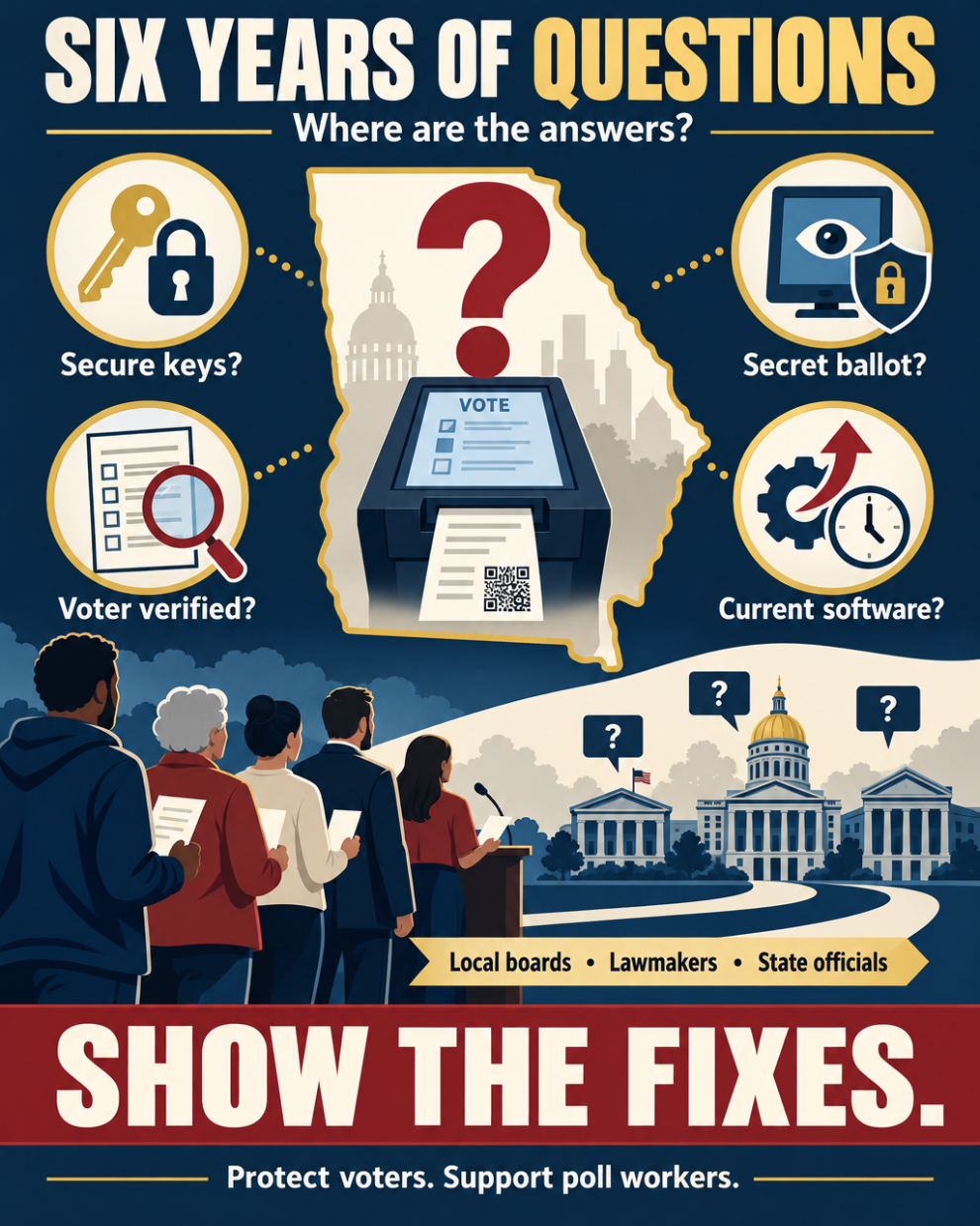
HAVA requires an auditable record and no one has been able to access those records. Georgia has received over $117,000,00 in funding to ensure HAVA requirements are met, “including that its voting system produces both a “record with an audit capacity for such system” and “a permanent paper record with a manual audit capacity for such system.” (See Section 301(a)(2)(A) and 301(a)(2)(B), respectively, of the Help America Vote Act of 2002).
In fact, in the order dated December 22, 2020, McBurney notes that the SEB “enjoys ‘full power to subpoena persons and papers’ OCGA § 21-2-33.” A footnote in the order explains McBurney’s rationale for the denial is pictured below:

Later in the order, McBurney again addressed the timeliness and apparent purpose of the SEB’s requests, writing that the “information may be a tad outdated (and the basis for the request somewhat politically motivated).” To many Georgians who have been investigating elections in the state, Judge McBurney’s repeated asides read as a predisposition to side with the status quo rather than with those pressing for greater scrutiny and reform.
Notably, the court will require Fulton County BRE to file an itemized cost breakdown for complying with each of the state’s eighteen requests by January 7, 2026. By January 14, the SEB has one week to challenge the cost estimates (Fulton estimates roughly $400,000 in costs to comply) and if challenged, the court will convene an evidentiary hearing on those costs. After that, the SEB may press for some or all of the items and Fulton County must comply upon payment.
While it is more widely known that it was Sherri Allen (a practicing attorney) in her capacity as Chair of the Fulton Board of Registration and Elections who filed this case against the state, it is not as widely known that she sued the state using taxpayer dollars “without the Board’s knowledge or consent” to block the subpoena, according to Kevin Moncla.
Fulton County Commissioner Bridget Thorne stated in a SEB meeting that Allen paid outside counsel “$600 an hour” to “block a subpoena. The State Board just wanted to see some records that they (Fulton County) had. Oh no, we are not going to be transparent. We are gonna spend hundreds of thousands of dollars to block them from looking at these documents.” According to Thorne, the ongoing expenditures at the time of the hearing “were $196,887 of taxpayer money.”
The firm alleged by Moncla and others to be “fraudulently acting as counsel under the color of law” to the Fulton County BRE is Kirkpatrick Townsend & Stockton. Moncla and others further claim it is the same firm that rebuffed Harmeet Dhillon’s October 30, 2025 request for Fulton County’s 2020 election records. The firm also rejected the SEB’s requests in a letter on October 22, 2025. Moncla and others also assert the firm is connected to Georgia General Counsel Charlene McGowan and that McGowan has repeatedly stonewalled multiple election investigations in the state.
A November 14, 2025, letter from the law firm states Fulton County officials
However, as Mc Burney ruled, not only does the SEB have the statutory right to access election materials, there is also a statute requiring the records to be provided to the Clerk of the Superior Court.
Former state senator and recent chairman of the Georgia Republican party, David Shafer sarcastically summarized Fulton County’s, unlawful, sloppily run elections in the simplest of terms in his December 22 post on X.

Georgia is arguably the blueprint for what can go wrong in elections, and it is not because the laws are not on the books. And, by the way, Fulton County isn’t alone in its malfeasance. The entire state of Georgia suffers from the same affliction. There are 159 counties in the state with many places to hide the fraud. Almost every county had some level of fraud, and it was mostly wrapped around the mail-in ballots. Why would Trump get approximately 73% of the early in-person voting and about the same for Election Day, ––but only 49% of mail in in many counties? This is where the important outrage lies, not in some Fulton County conciliatory admission.
But Governor Kemp and Secretary of State Raffensperger want you to believe elections are being run pristinely but Catherine Engelbrecht, founder of True the Vote, Kevin Moncla, Joe Rossi, Garland Favorito, and so many other diligent, (and, frankly, heroic) investigators argue otherwise. And despite the caricature, their work is not about relitigating 2020. It is about hardening the process for 2026 and beyond.
Drawing on decades of training grassroots volunteers in election oversight and administration, Engelbrecht produced a compelling roadmap, “The Way Forward,” laying out a “top ten” set of election reforms.

The document has not received the attention it merits, but its recommendations are practical and achievable, and by the way, they do not depend on the herculean task of eliminating voting machines on a two-year timeline.
On Monday, I asked Engelbrecht to comment on the state of America’s elections. Here is what she said,
“Elections are decided on margins far smaller than the known error rates in our voter-registration systems — before even accounting for process failures. That reality makes improvement urgent, not optional. For years, groups like True the Vote and countless citizen volunteers have done the unglamorous, technical work of documenting these weaknesses and demanding basic accuracy, transparency, and accountability.”
“That persistence is helping turn election integrity from rhetoric into reality.” Engelbrecht continued, “However, election integrity cannot be a post-mortem exercise. We have all seen that once the certification happens, the damage is done. So, as we look ahead to 2026, documentation alone will not be enough — we will need a prepared, nationwide army of citizen volunteers to monitor every step of the process and attorneys ready to defend the law, the data, and the voters themselves.”








Get the latest on Georgia delivered straight to your mailbox.

Election-fraud is the democrat party's most reliable voting-bloc.