





Please Follow us on Gab, Minds, Telegram, Rumble, GETTR, Truth Social, Twitter, Youtube
Access Georgians For Truth article directly via their site by clicking HERE
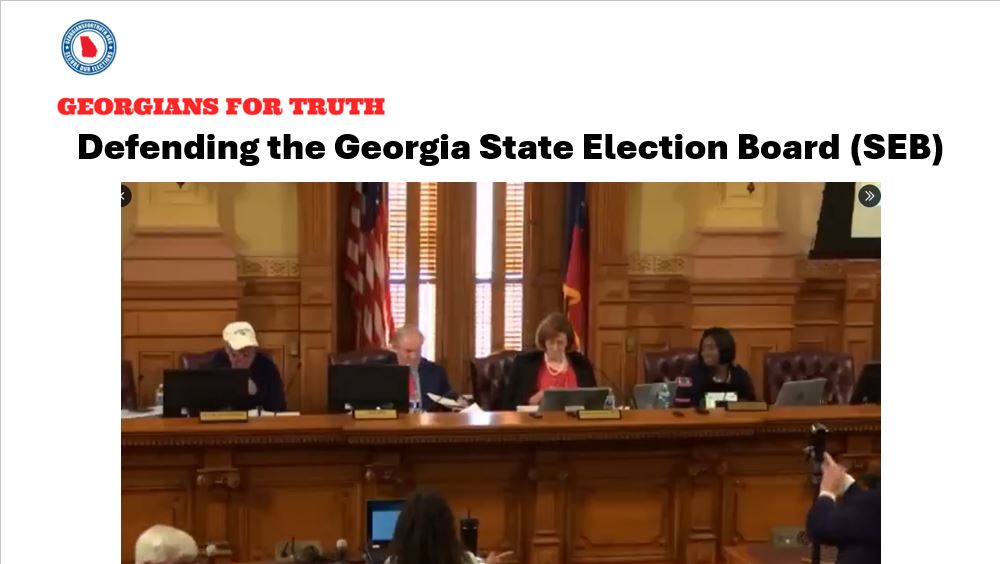
A coordinated narrative is taking shape in Georgia politics: the State Election Board is “ineffective,” “dysfunctional,” and “unable to process cases.” That storyline, pushed by political allies of Governor Brian Kemp and Secretary of State hopefuls, conveniently points to one solution—restructure or abolish the SEB, or fold it fully back under the control of the Secretary of State’s office. That would be a profound mistake for election integrity and public trust.
For years, the Secretary of State’s office effectively controlled the investigative pipeline. It decided which complaints to investigate, which to slow‑walk, and which—if ever—to send to the SEB. Most of what did reach the Board were low‑impact, technical violations: paperwork errors, minor procedural missteps, issues that rarely touched enough votes to alter an outcome. Meanwhile, serious 2020‑election cases with potential impact in the tens or hundreds of thousands of votes languished in limbo or were never meaningfully advanced.
The situation reached a new low when the Secretary of State’s office stopped sending investigators to SEB meetings to present and explain cases, cutting off members from the very staff who had handled the investigations. That is not the behavior of an office eager for accountability; it is the behavior of an office determined to control the narrative and limit scrutiny.
Against that backdrop, the recent push in some media outlets to brand the SEB “ineffective” looks less like neutral analysis and more like a political strategy: discredit the one body that has begun to ask hard questions, and then argue that only by neutering or abolishing it can Georgia “restore order.”
The clearest rebuttal to the “ineffective SEB” narrative is the very work the Board has finally managed to push forward—especially in two major 2020‑election cases that the system would likely have buried without an autonomous, persistent SEB.
The SEB2023‑025 matter—often associated with researchers Joe Rossi and Kevin Moncla—goes far beyond a clerical error or a mislabeled form. It involves:
Taken together, the evidence identifies more than 346 election‑law violations affecting over 41,000 votes. That is not a minor anomaly; that is a structural failure that reaches deep into public confidence in the 2020 results.
The case was heard on May 7, 2024, but the outcome—a mere letter of reprimand and an agreement for SEB approval of a Fulton County monitor for the 2024 general election—has been sharply criticized as inadequate to the scale of the violations. Worse, the monitor was the same individual who had overseen Fulton’s 2020 election, and selection came through a backroom deal orchestrated by Chairman John Fervier rather than a transparent vote by the full Board.
This outcome prompted a forceful response from Rossi and Moncla, who on October 15, 2025, sent a detailed letter to the SEB demanding Fervier’s immediate resignation. The letter accuses the Chairman of:
Through Open Records Request, authenticated text messages backing these allegations, and copies went to the Georgia Senate Ethics Committee.
Earlier, during public comments at an SEB meeting (captured in a six‑minute YouTube segment), Joe Rossi made a formal verbal complaint and resignation demand, with support from Amanda Prettyman and Sam Carnline.
Even with these irregularities in process and outcome, SEB2023‑025 underscores the value of an independent Board: it forced a hearing on a case that might otherwise have vanished, and persistent members and citizens have kept pressure on for real accountability rather than settling for a slap on the wrist and a recycled monitor. Without that autonomy, this case would likely have been buried entirely.
A second major 2020 case, often linked with David Cross and Kevin Moncla, exposes a different but equally troubling failure:
Unsigned tabulator tapes are not a mere formality; they go to the chain of custody and verification of machine totals. When that many tapes lack signatures, it raises systemic questions about whether basic safeguards were followed at all. The case was serious enough to be referred to the Attorney General—an step that underscores the scale of the problem.
Again, this is exactly the kind of case a truly independent SEB is uniquely positioned to surface and process. It is complex, politically explosive, and easy for partisan officials to downplay or delay. If not for members and staff determined to pursue it despite intense political pressure, these 148 unsigned tapes touching 315,000 votes might never have been meaningfully addressed.
Both SEB2023‑025 (Rossi/Moncla) and the Cross/Moncla case show why Georgia cannot afford to put the SEB back under the control of the very office whose handling of 2020 cases is in question.
If you listen only to the talking points, the SEB is a lumbering, partisan mess that cannot get through its agenda. The actual record tells a very different story—one of members and staff working overtime while key leadership figures undercut them at critical moments.
Based on an account by SEB Executive Director James Mills on FaceBook, less than 36 hours before what was slated to be a historic SEB meeting—featuring roughly 160 cases, including long‑delayed 2020 matters—Chairman John Fervier emailed that he would not attend. He:
When the time finally came to hear consequential cases, including major 2020 referrals, the Chair was absent and unreachable—no phone, no email, no leadership.
In his place, Vice Chair Dr. Jan Johnston stepped into the breach on extraordinarily short notice. She had already been working virtually every day for weeks with SEB staff to prepare the immense agenda. Together with member Janelle King and outgoing member Rick Jeffares, she carried the meeting through two intense back‑to‑back days, hearing and adjudicating more cases than any prior SEB session.
Mills further elaborates that these members:
That is not evidence of a Board that “cannot process cases.” It is evidence of a Board trying to work, despite internal resistance and external political pressure, to do exactly what Georgia needs it to do: review serious violations, enforce the law, and restore some measure of confidence that the facts—not the spin—will prevail.
Now, instead of strengthening that emerging backbone, political pressure appears to be building for the opposite. Rumors abound that:
Speaker Jon Burns is being urged to remove Janelle King, one of the Board’s most outspoken and diligent members. Legislative and executive leaders are exploring ways to:
The justification offered is familiar: efficiency, clarity, “streamlining.” In reality, it would accomplish something very different: it would return control over investigations, referrals, and the timing of cases to the same office that for years filtered out high‑impact 2020 matters and recently stopped even sending representatives to defend its own work before the Board.
An SOS cannot credibly “oversee itself” on questions as serious as double‑scanned ballots, missing images, unsigned tabulator tapes, and hundreds of alleged violations tied to pivotal elections. Bringing the SEB back under the Secretary of State would gut the only structurally independent venue Georgia has for examining those problems.
Targeting Janelle King in particular is especially revealing. Her removal would not suddenly make the Board more “functional”; it would remove one of the few members consistently willing to ask hard questions, insist on transparency, and push to prioritize serious, outcome‑relevant cases ahead of cosmetic, low‑impact ones.
If Georgia wants real election integrity—not just the appearance of order—then the path forward is the opposite of what the narrative engineers are selling. Rather than abolish or neuter the SEB, the state should:
Georgia’s voters deserve more than a carefully managed narrative about “dysfunction.” They deserve a system where credible evidence of large‑scale irregularities is investigated, heard, and resolved transparently—without fear or favor.
An independent, empowered State Election Board, with members like Jan Johnston and Janelle King willing to do the hard work, is not the problem. It is one of the last remaining safeguards against a system where the same office that runs elections also decides which of its own failures the public is allowed to see.
Field Searcy is co-founder of GeorgiansForTruth.org, a grassroots volunteer effort to bring election integrity to Georgia. Visit for more information and supporting documentation.









Get the latest on Georgia delivered straight to your mailbox.